HEALab
About Us
Welcome to the Health Equity Analytics Lab (HEALab)! Our lab is a space for scientists, trainees, and community members to explore publicly available data and participate in research focused on social drivers of health in Latino/x populations and other historically excluded groups.

Our Mission
In our research, we employ advanced quantitative methodologies to capture the intricate aspects of social infrastructure. These methods include advanced longitudinal analyses, latent modeling, person-centered analyses, as well as non-linear techniques such as social network analysis and geographic information systems analysis. By leveraging both publicly available data and data we collect, we aim to uncover unique layers of an individual's social environment.
We encourage underrepresented trainees to join us. Scientists and trainees from underrepresented backgrounds often face significant challenges, including interpersonal and structural racism, gender bias, and sexual prejudice. Our mentoring experiences are designed to promote equity and to help mitigate these stressors and support the success of early-career, diverse trainees.
Above all, our lab fosters a cooperative and warm collaborative research environment that emphasizes strengths and the shared success of everyone.
Meet The HEALab Team

Melissa Flores, PhD
Principal Investigator
Dr. Flores (she/her) is an assistant professor in the Department of Psychology at the University of Arizona. As an interdisciplinary scientist, her primary focus is understanding the complex interplay of social and structural factors contributing to health disparities within the Latino/x population as well as other historically excluded groups. Her approach is centered on resilience while employing advanced quantitative methods to model social environments. Her ultimate goal is to establish links between these environments and health outcomes, such as cardiovascular health and disease across the lifespan.
Dr. Flores is also a distinguished National Heart, Lung, and Blood Institute (NHLBI) R00 MOSAIC Fellow. Within her MOSAIC project, she leverages machine learning techniques to optimize cardiovascular risk assessment specifically tailored to the Latino/x communities.
Dr. Flores is dedicated to fostering diversity in academia. She actively engages in mentoring activities across various academic disciplines and is committed to strengthening the academic pipeline for scholars from underrepresented backgrounds.

Mariella Rodriguez, BS
Research Coordinator
Mariella (she/her) is a research coordinator for the HEALab. She is also an MPH student in Epidemiology in the Department of Epidemiology and Biostatistics in The Mel and Enid College of Public Health. Her expertise lies in data and project management.

Riley O'Neill, MA
Graduate Student Collaborator
(Ruiz Lab)
Riley is a doctoral candidate in the University of Arizona's Clinical Psychology program with a minor in Health Psychology. Her research examines how stress and sociocultural contexts contribute to socially driven mechanisms of cardiovascular disease. Specifically, she is interested in studying how structural and social forces contribute to some people feeling less secure and more stressed, in addition to exploring how such experiences influence risk for cardiovascular disease.

Giovanni Marquez, BS
Lab Alumni
Giovanni (he/him) is a doctoral student in the Clinical Psychology program at The University of Utah.

Hatty Lara, MS, MA
Graduate Student Collaborator
(Gomez Lab)
Hatty (she/her) is a doctoral student at the University of Arizona in the Clinical Psychology Ph.D. program. She graduated with a B.S. in Psychology at the University of Texas at El Paso and an M.S. in Psychological Sciences at the University of Texas at Dallas. She worked as a Research Assistant at UT Southwestern Medical Center and then as a Project Coordinator at Texas Tech University Health Sciences Center El Paso before matriculating at the University of Arizona.
Hatty's clinical focus is on cognitive behavioral therapy (CBT), acceptance and commitment therapy (ACT), insomnia interventions, and family-based therapies. Hatty has a bicultural focus and is particularly interested in working with English and Spanish-speaking children and families.

Savannah Boyd, MS
Graduate Student Collaborator
(Sbarra Lab)
Savannah’s interests are at the intersection of adult social relationships and health. She completed a bachelor’s degree in psychology at the University of Georgia and a master’s in family studies and human development at the University of Arizona. She’s a clinical psychology graduate student specializing in couple therapy and health psychology. Her dissertation utilizes advanced quantitative methods to interrogate the potentially causal link between loneliness and objective health outcomes among older adults.
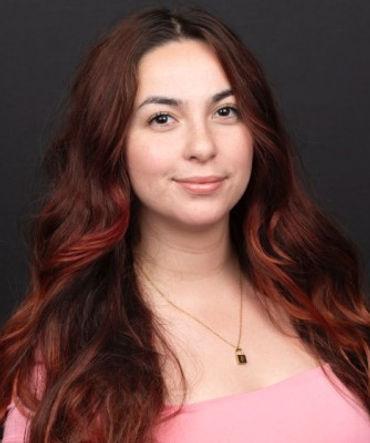
Victoria Rueda, BS
Graduate Student
(HEALab)
Victoria is a doctoral student in the University of Arizona's Clinical Psychology program with a minor in Health Psychology. She originally joined the HEALab as an undergraduate McNair Scholar to examine how Latino/e culture intersects with social networks and familial dynamics to shape cardiometabolic health outcomes. She is especially interested in social drivers of cardiovascular outcomes among pregnant persons. Moreover, Victoria is passionate about serving Spanish-speaking populations and aims to advance culturally responsive research that highlights resilience while addressing health disparities in historically underserved communities.

Rebeca A. Jiménez , MA
Graduate Student
(HEALab)
Rebeca (she/her/ella) is a first-year doctoral student in Clinical Psychology at the University of Arizona. She earned her MA in Psychology, with an emphasis in Physical and Mental Health Research, and her BA in Psychology and Spanish from San Diego State University. Her graduate work explored the role of social support in the associations between perceived neighborhood adversity and depression and anxiety symptoms in a low-income migrant community on the U.S.–Mexico border. Rebeca previously worked as a lab manager, overseeing mixed-methods studies, clinical trials, and tobacco policy initiatives. Her research interests center on using community-based approaches to develop culturally responsive interventions that reduce health disparities, particularly those related to depression and cardiometabolic conditions, and improve access to care for underserved populations.

Melanie Garcia , BA
Research Coordinator
(HEALab)
Melanie (she/her) is a research coordinator for the HEALab. She graduated with a BA in Psychology with a minor in Human Services at the University of Nevada, Las Vegas. Melanie's research interests lie in investigating sociocultural influences on mental health outcomes and service access in Latine populations. She is particularly interested in the ways that biculturalism, social networks, and exposure to racism and discrimination influence psychological well-being and help-seeking behaviors. Melanie aims to adapt culturally responsive mental health care and reduce disparities in mental health service utilization in underserved communities.